%20--%3e%3cpath%20d='M200.3,58.2c-2.5-2.5,1.1-6.8,3.3-4.2s-.9,6.5-3.3,4.2Z'/%3e%3ccircle%20cx='25.7'%20cy='49.3'%20r='2.4'/%3e%3cpath%20d='M87.2,63.9c0,0,.3.7.4.6,1.3-.9,3.4-4.2,4.8-4.4s3.2,1.2,2.8,3-5.6,5.5-6.7,7.5c0,.6,1.7,5.3,2.1,5.6,1.2,1.1,3.9-.8,4.7-1.8,3.4-4,6.1-10.1,8-15s2.1-6.4,3.6-9.4c-3.1-1.4-7.2-.7-9.7,1.5-1.5,1.2-3.2,4.4-5.3,1.5s3.2-6.2,5.3-7.2c3.8-1.8,7.7-1.6,11.7-.5,1.1-2,1.5-7.7,5-5.4s.3,4-.1,5.9-.2.4.1.6c4.3.7,9,2.7,13.1.6s2.2-1.9,3.2-3.8,3.1-2.4,4.2-.4-1.3,5.6-3.1,7c-5.8,4.8-12.8,2.4-19.4.9l-.4.2-5,13c-.6,2.2-.7,9.6.2,11.6,1.9,4.3,7.3-1.4,8.9-3.3s1.8-2.3,1.5-2.8c-4.3-2.6-4-10.8.9-12.5,5.7-2.1,7.3,4.9,5.7,9,2.6.3,8.2-5.3,10-1.8s-.5,2.6-1.1,4.1-1.6,6.5-.3,7.5,3.9-1.3,5.1-1.8c-.2-4.1,1.3-8.8,4.6-11.3s10-1.3,8.4,4.9-4.5,6.1-7.1,8.5c1.3.1,2.6-.7,3.6-1.5,3.5-2.8,8.1-10.8,12.4-11.6s4.6,2.9,4.8,5.3c2.4-4.9,8.9-7.6,12-1.8,2.3-2.8,6.2-5.7,9.6-2.9s0,10.1-1,14,0,.5.4.4c.8-.2,2.6-1.7,3.2-2.3,2.2-1.9,4.6-4.9,6.1-7.4s2.1-6.5,4.6-6c4.1.7.4,6.7-.2,9s-1.2,5.3,0,7.5c1.5.3,7.7-4.8,8.9-6.1s1.8-2,2-2.5c.6-1.2-.6-1.9-1.1-3-1-2.1-1.5-4.7-.2-6.8,1.9-3,5.7-2.3,7.1.8s.4,5.6.1,8.1l2.7,4.7c2.4-1.3,5.6-2.1,8.4-2.3s7.2-.3,8.5.8,1,3.6-1,4.1-5.2-.2-7.3,0-5.3.9-6,1.5,0,1.6.1,2.4c0,1.2.1,2.4-.4,3.5-1.8,3.4-7.4,3.1-8.4-.7s1-4.4,2.3-6.3l-1.5-3.1c-3.2,3.3-10.1,10.3-15.1,9.7s-4.5-3.5-4.4-6.2c-2.6,2.5-7.7,7.4-11.6,5.2s.7-11,.6-15.2c-.2-.2-2,1.2-2.2,1.4-2.3,2.1-3.8,5.4-5.1,8.2s-1.6,5-2.6,5.7c-1.7,1.2-3.5,0-3.8-1.9l2.7-9.7c0-.8.1-1.7,0-2.5s-.8-.4-1.3-.3c-3.3,1.2-5.8,10.8-7.8,13.5s-4.5,1.5-4.7-1,1.1-6.2,1.2-8.5,0-2.6,0-3.9c-4.6,3.6-9.4,13.2-16.1,12.5-1.4-.2-3-1.1-3.8-2.3-3.3,1.8-7.2,3.9-10.4.6s-2.2-6.1-1.8-9.1l-5.2,1.1c-2.7,4.8-9.3,12.9-15.6,10.4s-4.9-4.9-4.6-8c-2.1,2.5-3.3,5.3-6.4,6.7-5.4,2.5-9.1-.5-10.5-5.7-3.9,3.4-7.7,7.8-13.5,7.2s-3.9-1.6-5.3-3.2c-2.9,1.9-6.4,4.5-9.3,1.1s.8-12.1-1.1-16.6c-1.8-.3-5.1,6.4-5.9,7.8s-1.8,2.5-2.5,3.8-1.5,4.4-2.5,5c-1.4.9-4.2-.5-4.6-2.1l-.4-10.1-.5-3.6c-1.6,2.9-2.9,6-4.6,8.7s-5.9,8.3-8.6,9.1c-7.4,2.2-7.6-6.5-7.2-11.4s2.7-11.5,4.1-13.9,4-1.4,4.4.5-1.7,6-2.3,7.9-1.4,4.8-1.4,5.3v6.8l.4.4c.3,0,.6,0,.9,0,.9-.3,4.7-5.2,5.4-6.3,2.1-3.1,5.7-12.5,9.5-13.3,5.5-1.1,4.5,9.6,4.8,12.7l3.4-5.7c1.4-2.1,3.9-5.6,6.5-6,6.8-.9,6.6,7,6.4,11.6s-1.2,6.3-.3,6.4c.8-.1,4-2.2,4.2-2.8.4-.9.5-3.5.8-4.7,1.1-4.7,5.6-12.4,11.5-9.5s-.9,10.1-3.3,12.8-3.4,3.1-3.5,3.3c-.2.9,1.3,1.6,2.1,1.6,4,.2,8.5-5.3,11-8,.3-.7-.6-5.1-.6-6.4,0-2.1-.5-6.9,3-5.8s1.7,1.6,1.7,2.3c0,1.3-.2,3.3,0,4.5ZM70.8,68c.6-.2,2.9-3.5,2.7-3.7-1.4.6-2.5,2.3-2.7,3.7ZM142.8,70.2c.9-.1,3.4-3.5,3-4-1,0-3.4,3.4-3,4Z'/%3e%3c/svg%3e)
06. In Institutional Branding, Operational Constraints Are Part of the Strategy
A brand does not live in a platform. It lives in use.
The sixth difference is the one often discovered too late: a brand does not live in a platform. It lives in use.
It lives in reports, web pages, newsletters, invitations, speeches, policy papers, PowerPoint templates, videos, LinkedIn posts, press releases, events, campaigns, co-funded projects, co-signatures, translations, legal validations and materials produced under pressure by teams that are not always made up of designers.
In the institutional world, branding that cannot be deployed is badly designed branding.
The classic separation between strategy and execution therefore becomes dangerous. A brilliant brand platform that cannot be translated into several languages, applied in constrained formats, used by non-specialist teams, maintained in co-branding or brought to life in politically sensitive contexts is not a good strategy. It is an intention that has not yet met the real conditions of its existence.
The European Commission's Europa Web Guide shows this clearly: the institutional web presence is governed by an official rulebook covering editorial, legal, technical, visual and contractual aspects. The Europa Component Library, in turn, provides a comprehensive guide to the design elements and visual standards that make up Europa websites and applications. This means that institutional design is not only a style. It is a production infrastructure.
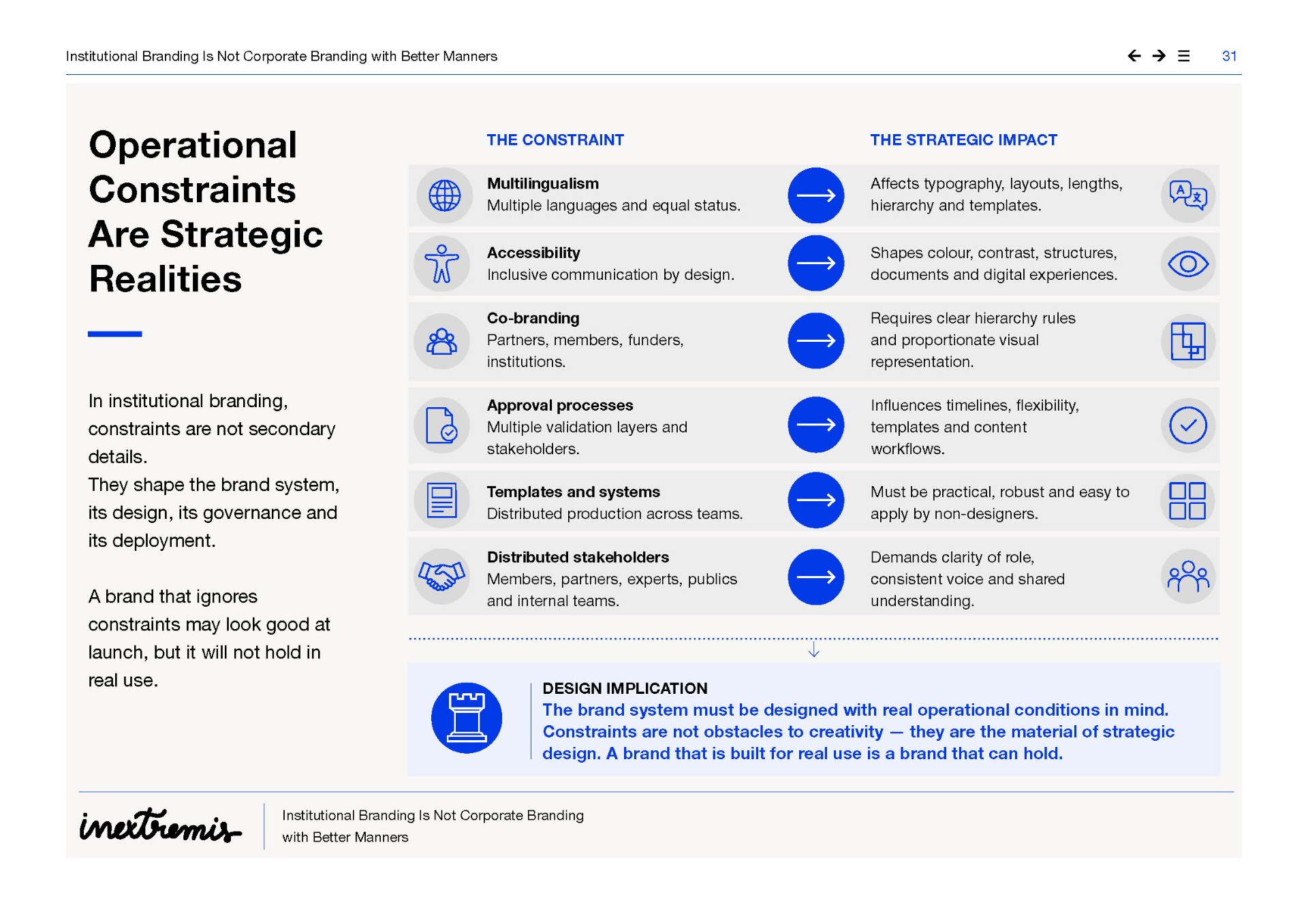
Multilingualism
In a European environment, multilingualism is not a detail of adaptation. It affects typography, grids, headline lengths, buttons, components, layouts, covers, infographics and signatures. An identity that works in English but collapses as soon as it moves into French, German, Polish or Greek is not ready for a European organisation.
Accessibility
The EU Web Accessibility Directive requires public sector bodies in the European Union to make their websites and mobile applications accessible. The technical requirements refer in particular to the harmonised standard EN 301 549, which incorporates WCAG 2.1 Level AA requirements for web content.
In institutional branding, accessibility is therefore not merely compliance. It is a dimension of the brand. An institution that communicates in an inaccessible way weakens its implicit promise of service, openness and responsibility.
Co-branding
In European projects, communication and visibility obligations are not decorative. The Commission recalls that beneficiaries of EU funding must acknowledge the origin of the funds received and ensure the visibility of the European Union. The rules on the use of the European Union emblem specify that the emblem is the main visual sign allowing the origin of EU funding to be recognised.
An institutional or association brand must anticipate situations in which it will not stand alone: member logos, partners, institutions, funders, coalitions, projects and events. It must organise visual hierarchies before each project improvises them. It must define who leads, who supports, who funds, who represents and who guarantees.
Formats and editorial design
A European institution or association rarely produces only one type of material. It publishes long documents, summaries, reports, position papers, educational content, invitations, press releases, social posts, videos, slides, newsletters, stands, web pages and calls for input. Each format imposes a different logic. A report requires structure. A post requires a hook. A consultation requires precision. A video requires rhythm. An event requires a spatial experience.
Branding must therefore be transmedia without becoming scattered. That is why editorial design is as important as visual identity. In the institutional world, the brand lives in the organisation of content.
Many European associations operate with small teams, constrained budgets, multiple suppliers, active members, working groups and partners. Without a clear system, every material becomes an exception. Every event invents its own universe. Every project creates its own mini-brand. Every team interprets the guidelines in its own way.
Design must therefore become a technology of coherence.
It must provide simple rules, robust templates, reusable components, clear examples, levels of autonomy, co-branding rules, principles of editorial hierarchy and practical safeguards that people can actually use. In the institutional world, operational constraints are not the enemies of strategy. They are its raw material.
What This Means in Practice
- ●Test the system in real formats before approving it.
Try it on a report cover, social post, PowerPoint slide, event banner, newsletter and co-branded page.
- ●Check multilingual resilience.
Headlines, grids, buttons, diagrams and templates must survive translation into longer languages.
- ●Build accessibility into the design system.
Contrast, typography, alt text, chart readability and document structure should be treated as brand standards.
- ●Prepare co-branding scenarios in advance.
Include examples for EU funding, partner logos, member logos, project signatures and institutional endorsements.